Choose Your Facebook Post
Open the photo, video, or other supported Facebook post you want to receive likes. Copy its direct URL and make sure the content is public and accessible. Record the current like count before ordering.
Give your Facebook posts the attention they deserve with high-quality likes delivered to your photos, videos, and other supported posts. Buy Facebook Likes from $3 per 1,000 with flexible packages ranging from 10 to 100,000 likes and country targeting available. Most orders start within 3 hours, delivery can reach 50,000 likes per day, and every package includes 30-day refill coverage for eligible decreases.
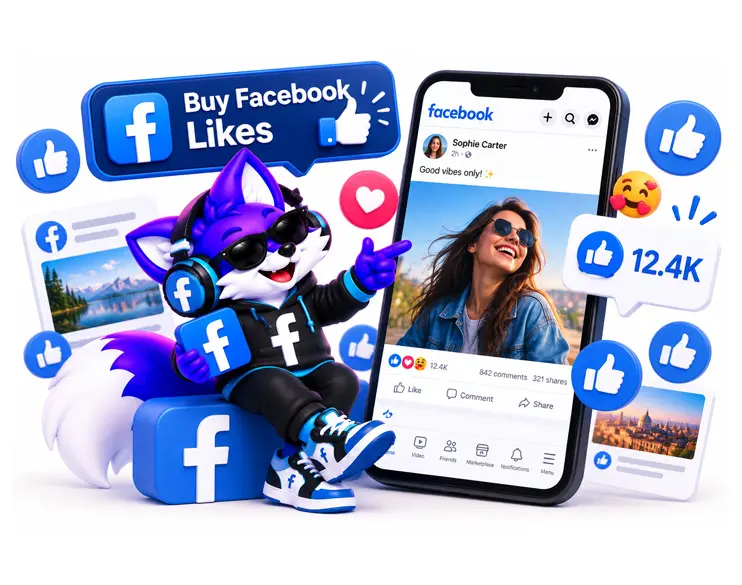
Choose a smaller package for a single post or select a larger quantity for your photos and videos. Every standard package follows the same $3-per-1,000 base rate, with high-quality account delivery and 30-day refill support.
Facebook Likes Service
Buy Facebook Likes for your public Facebook posts with flexible quantities, country targeting, and dedicated delivery support.
Base price: $3 per 1,000 likes
Minimum order: 10 likes
Maximum order: 100,000 likes
Daily delivery: Up to 50,000 likes
Start time: Within 48 hours, usually under 3 hours
Refill coverage: 30 days
Country targeting: Available
Account quality: High-quality accounts
Supported content: Photos, videos, and eligible Facebook posts
Required visibility: Public and accessible
Prices are calculated using the standard $3-per-1,000 rate. The final price of targeted packages and any applicable checkout minimum are displayed in the order panel.
Select your quantity, review the available targeting options, and confirm your final price in the panel.
Build Your PackageLikes for Photos, Videos, and Facebook Posts
MifaSocial supports likes on different types of eligible Facebook posts, including photos, videos, and standard feed posts.
Submit the direct URL of the content you want to receive likes.
The service focuses on the selected post rather than automatically increasing the overall likes or followers of your Facebook Page.
Dedicated Facebook Like Delivery
This package delivers the standard Facebook Like reaction.
Love, Haha, Wow, Sad, Angry, and other supported reactions are separate service options.
Choose this package when you specifically want likes rather than a mixture of reaction types.
Choose Your Country or Regional Option
Country targeting is available across MifaSocial's supported Facebook service options.
Available country labels include:
Additional language and regional options include:
Language and regional labels are not necessarily the same as individual countries.
Confirm the selected targeting option, availability, and final package price before checkout.
High-Quality Facebook Accounts
MifaSocial uses high-quality account options for Facebook like delivery.
The service focuses on increasing the accepted likes on your selected post.
Additional comments, shares, video views, Page followers, and other reactions are not included or guaranteed.
Facebook controls final account and engagement validation.
Up to 50,000 Likes Per Day
Delivery capacity reaches up to 50,000 likes daily.
At the maximum rate, a 50,000-like package can take approximately one day after starting.
A 100,000-like order requires at least around two days at the same rate.
Actual completion time depends on the selected quantity, targeting option, and service conditions.
Most Orders Start Within 3 Hours
Most Facebook like orders begin within 3 hours.
The maximum stated start window is 48 hours.
Keep the submitted post publicly accessible throughout delivery so the selected accounts can reach the correct destination.
30-Day Refill Coverage
Every package includes 30-day refill coverage for eligible order-related decreases.
If a qualifying drop occurs during the covered period, MifaSocial can review your order and arrange replacement delivery according to the applicable service terms.
Refill provides support for eligible service-related issues. It does not guarantee permanent retention or override Facebook's engagement validation.
A Clear No-Start Refund Policy
If the order does not start within 72 hours after its stated start deadline, it qualifies for a full refund.
The maximum stated start window is 48 hours. The additional 72-hour refund threshold applies after that deadline.
Keep Your Facebook Post Public
Submit the direct URL of the Facebook post, photo, or video that should receive likes.
Make sure the content is public and accessible to the delivering accounts.
If the post is deleted, made private, or becomes unavailable during delivery, the order is treated as completed under the service conditions.
No Facebook password or administrator access is required.
How to Build Your Facebook Likes Order
Choose the quantity, confirm any targeting requirements, and submit the direct URL of your public Facebook content.
Choose your Facebook post, select the number of likes and targeting option, and monitor delivery against your starting like count.
Open the photo, video, or other supported Facebook post you want to receive likes. Copy its direct URL and make sure the content is public and accessible. Record the current like count before ordering.
Choose between 10 and 100,000 likes at the standard $3-per-1,000 rate. Select an available country, language, or regional option if targeting is important, and confirm the final price before checkout.
Most orders begin within 3 hours, with delivery capacity reaching up to 50,000 likes daily. Monitor the selected post and use the 30-day refill support if an eligible order-related decrease occurs.
Buy Facebook Likes with high-quality accounts, flexible quantities, country targeting, fast delivery, and dedicated support for your selected post.
Choose a photo, video, or other supported Facebook post. MifaSocial focuses on delivering the standard Like reaction to your selected content rather than combining several unrelated engagement services.
Select from supported countries, languages, and regional packages when your order has a geographical requirement. Check the exact targeting option and final price before placing your order.
Most orders start within 3 hours, and delivery capacity reaches up to 50,000 likes per day. Choose between 10 and 100,000 likes according to your content and order requirements.
Every package includes 30-day refill coverage for eligible order-related decreases. MifaSocial also provides a defined no-start refund policy and support throughout the order process.
Choose 10–100,000 Facebook likes with country and regional targeting, up to 50,000 daily delivery, and 30-day refill coverage.
Before you Buy Facebook Likes, compare the type of reaction, supported post formats, quantity limits, targeting options, delivery capacity, and refill conditions.
MifaSocial provides dedicated Facebook post likes with a clear $3-per-1,000 base rate, packages ranging from 10 to 100,000, and delivery capacity of up to 50,000 likes daily.
The service supports different eligible post formats, provides country and regional targeting options, and includes 30-day refill coverage for qualifying decreases.
Page Likes, other emoji reactions, additional video views, and comments remain separate services. You can select the specific interaction you need without purchasing unrelated products.
A new photo post, an established video, and a country-focused campaign have different requirements. Choose a package based on the content and the result you actually need.
Start with 10 to 250 likes when you need a smaller order. Check that the post is public, select your quantity, and review the delivery process before choosing a larger package.
Choose between 500 and 5,000 likes when you have an eligible photo or video with a specific like-count target. Record the post's existing likes so you can monitor the delivered quantity.
Select an available country or regional package when your post has a geographical requirement. Check the targeting label, availability, and final price before confirming your order.
MifaSocial supports packages of up to 100,000 likes, with daily delivery capacity reaching 50,000. At the maximum rate, the largest package requires at least around two days after delivery begins.
Select your public Facebook post, choose between 10 and 100,000 likes, and confirm your preferred targeting option. Build your package with high-quality account delivery and 30-day refill coverage.
Choose the Right Likes for Your Facebook Content
Understand post likes, compare supported content, choose a suitable quantity, and review the delivery conditions before placing your order.
Buy Facebook Likes when your specific objective is to increase the number of standard Like reactions on a Facebook post. MifaSocial uses high-quality account options and supports packages ranging from 10 to 100,000 likes. The service is designed for different types of eligible Facebook content, including photos, videos, and standard posts. It focuses on the Like reaction rather than delivering a random mixture of emotional reactions. Comments, shares, Page followers, additional video views, and other reactions are not automatically included. Every package includes 30-day refill coverage for eligible order-related decreases. Facebook independently controls account validation, accepted interactions, and final reporting.
MifaSocial supports likes on photos, videos, and other eligible Facebook posts. You can select a product photo, a video published on your Page, a public announcement, or another supported post. The important requirement is that the content is publicly accessible and has an eligible Like option. Submit the direct URL of the specific content you want to receive likes. A Page URL is not interchangeable with a post URL. Availability for specialized formats, including Reels, should be checked against the selected service in the order panel. Keep the original post accessible throughout the delivery period.
This is one of the most important distinctions when selecting a Facebook engagement service. Post Likes apply to an individual Facebook publication. They increase the accepted Like reactions associated with the selected photo, video, or post. Page Likes relate to the Facebook Page itself rather than one publication. Facebook's newer Pages experience also places greater emphasis on followers rather than Page Likes. If your objective concerns the Page rather than an individual post, review Buy Facebook Page Likes separately. Purchasing likes for one post does not automatically increase your Page's likes or followers.
Facebook offers several ways to react to a post. The standard Like reaction is different from Love, Haha, Wow, Sad, Angry, and Care. This service focuses specifically on standard Facebook Likes. It does not automatically deliver a mixture of other reaction types. If you need different emotional reactions on your content, review Buy Facebook Emoji Reactions as a separate service. Keep in mind that Facebook can display an aggregate reaction count as well as individual reaction types. The total reaction count should not automatically be interpreted as the number of standard Likes. Learn more about these differences in Meta's official Facebook Reactions Guide .
MifaSocial offers country, language, and regional targeting for Facebook Likes. Supported country options include USA, Canada, Brazil, Japan, South Korea, India, Indonesia, Vietnam, Pakistan, Bangladesh, Nigeria, Egypt, Sweden, Philippines, Lithuania, Peru, Switzerland, Portugal, Georgia, Cyprus, and China. Additional language and regional labels include Arabic, North Africa, French, German, and Turkish. Country targeting allows you to select an available geographical service. It does not guarantee that the delivered accounts will become customers, follow your Page, or interact with future posts. Confirm the selected option, availability, and final price before checkout.
MifaSocial offers packages ranging from 10 to 100,000 likes. Start by checking your post's current reaction count and identifying the additional quantity you need. Smaller packages are available when you have a limited order requirement. Larger packages support higher like-count targets on eligible public content. At MifaSocial , the standard base rate is $3 per 1,000. A package of 1,000 likes costs $3, while 10,000 likes cost $30 at the base rate. There is no official Facebook formula requiring every post to maintain a fixed ratio between likes, reach, views, and comments. Choose the quantity that matches your actual requirements.
Facebook displays reactions on eligible posts, including photos and videos. Page administrators can also review available post performance metrics through Meta Business Suite and Page Insights. These tools provide information about reactions, reach, and other content interactions. The exact metrics available depend on the account type, content format, reporting interface, and current Meta features. Personal profiles may have different reporting capabilities from professional Pages. Your total reaction count can also contain Love, Haha, and other reaction types. Record the starting Like count before ordering so you can review delivery against the original number. Facebook controls final validation and reporting.
Most MifaSocial Facebook Like orders begin within 3 hours. The maximum stated start window is 48 hours. Delivery capacity reaches up to 50,000 likes per day. At the maximum delivery rate, a 50,000-like package can take approximately one day after starting. A 100,000-like package requires at least around two days at the same rate. Actual completion can vary according to the selected quantity, targeting option, and service conditions. Keep the post public until delivery finishes.
Facebook uses many signals when determining which posts appear in Feed. User interactions, content relevance, relationships, and predicted user preferences can influence content distribution. Likes are one form of interaction, but the number of Likes alone does not determine how widely a post is distributed. Purchased likes do not guarantee additional organic reach, Feed recommendations, or more customers. Meta also takes action against attempts to manipulate engagement and content distribution. If your main requirement is video playback rather than standard Likes, review Buy Facebook Views separately. Choose each service for its stated delivery metric, not a guaranteed algorithmic result.
No. Likes, comments, and shares represent different Facebook interactions. The standard Like package does not include comments or shares. A comment is a written response beneath a post. If comments are the specific interaction you need, review Buy Facebook Comments . Sharing is another separate action. If your objective is to order shares rather than Likes, consider Buy Facebook Shares . Purchasing multiple services does not guarantee organic audience growth or improved distribution.
The service requires a public and accessible Facebook post. If the content is deleted, made private, or becomes unavailable during delivery, normal processing cannot continue. Under the service conditions, an order is treated as completed if the target post is removed during delivery. This makes the destination URL an important part of the order process. Before checkout, open the link and confirm that it points to the exact photo, video, or post you want. Keep the content accessible throughout the delivery period.
MifaSocial provides 30-day refill coverage for eligible order-related decreases. If a qualifying drop occurs during the covered period, support can review your order and arrange replacement delivery according to the applicable service terms. The no-start refund policy is separate. If delivery has not started within 72 hours after the stated 48-hour start deadline, the order qualifies for a full refund. Meta actively identifies and removes accounts or engagement involved in platform manipulation. High-quality delivery and refill coverage do not guarantee permanent acceptance or immunity from Meta's enforcement systems. Refill is a service-support commitment, not a guarantee against every possible platform action. Meta explains its approach to artificial engagement in Cracking Down on Spammy Content .
Select your public Facebook photo, video, or eligible post. Choose between 10 and 100,000 likes, confirm your preferred targeting option, and build your package with clear delivery terms and 30-day refill coverage.
Answers about Facebook post likes, supported content, country targeting, delivery speed, reactions, Insights, refill coverage, and refund conditions.
The standard rate is $3 per 1,000 likes. A package of 100 likes costs $0.30 at the base rate. The final price of targeted packages is shown in the order panel.
You can order between 10 and 100,000 Facebook likes for an eligible public post.
Most orders begin within 3 hours. The maximum stated start window is 48 hours.
Delivery capacity reaches up to 50,000 likes per day. Actual completion depends on the selected quantity, targeting option, and service conditions.
Every package includes 30-day refill coverage. Eligible order-related decreases can be reviewed during that period.
If delivery does not start within 72 hours after its stated start deadline, the order qualifies for a full refund. The maximum stated start window is 48 hours.
Yes. MifaSocial supports country, language, and regional targeting. Confirm the selected option and its final price before checkout.
Available options include Bangladesh, Egypt, Pakistan, Arabic, North Africa, Nigeria, French, German, Japan, Brazil, Turkish, Vietnam, USA, Indonesia, South Korea, China, India, Sweden, Philippines, Lithuania, Peru, Switzerland, Portugal, Georgia, Cyprus, and Canada. Some options are language or regional service labels rather than individual countries.
MifaSocial supports eligible Facebook photos, videos, and standard posts. Specialized formats should be checked against the selected service in the panel.
Yes. The submitted post must remain public and accessible throughout delivery. Private or unavailable content cannot receive normal delivery.
No. This package focuses on the standard Like reaction. Love, Haha, Wow, Sad, Angry, Care, and other supported reactions are separate service options.
Facebook provides post engagement and reaction metrics through its available reporting interfaces. Page administrators can review supported post metrics through Meta Business Suite and Page Insights. Final reporting remains subject to Meta's validation.
If the target post is deleted, made private, or becomes unavailable during delivery, the order is treated as completed under the service conditions.
Likes are one of several engagement signals considered by Meta. Purchased likes do not guarantee additional organic reach, Feed placement, or more customers.
Yes. Meta can identify and remove invalid engagement or take action against accounts. Eligible order-related decreases can be reviewed during the 30-day refill period.
Page owners, content creators, businesses, and social media managers who specifically need likes on eligible Facebook posts are the primary customers.
It is optional. Likes, views, comments, and shares represent different interactions. Choose each service according to the metric you need.
Post Likes apply to an individual publication. Page Likes relate to the Facebook Page itself. This service focuses on eligible posts, not on increasing the Page's likes or followers.
Choose your public Facebook post, select between 10 and 100,000 likes, and confirm your preferred targeting option. Review the delivery conditions and 30-day refill coverage before placing your order.
Build Your PackageExplore more Facebook services for your posts, videos, Page, profile, groups, events and live streams. Find the right combination of likes, views, followers, comments, shares and other engagement services for your Facebook goals.